
A client walked into our Mumbai office last year with a printout of his demat holdings. Fourteen stocks, bought over six years, most of them on the strength of a WhatsApp group, a television panel or a friend's cousin who "works in the sector". He wanted to know why his portfolio had barely kept pace with a plain index fund his wife had started with a small monthly SIP. He wasn't careless. He was smart, hardworking and had put real hours into it. The hours were exactly the problem.
This article is about that gap. We are not going to tell you direct stocks are bad or that mutual funds are magic. Both are legitimate ways to own Indian businesses. What we will do is lay out what each route actually costs you in rupees, in time and in mistakes, so you can decide with open eyes.
The "Do It Yourself" Myth
Somewhere along the way, investing became a matter of pride. Picking your own stocks feels like being in control, and paying a fund manager feels like paying someone to do what you could do yourself. That instinct is understandable, and it is also expensive.
The uncomfortable evidence points in one direction. The S&P SPIVA India scorecard, which compares active fund managers with their benchmarks, has repeatedly shown that a large share of actively managed funds fail to beat their index over longer periods. If trained professionals with research teams struggle to do it consistently, an individual working evenings and weekends is not starting from a stronger position. Studies published by the market regulator on individual traders point the same way: a majority of retail participants in the equity derivatives segment lose money, and many active equity traders do worse than a simple buy-and-hold approach.
What "Costs More" Really Means
When we say do-it-yourself investing costs more, most people think of fees. Fees matter, but they are the smaller half of the story. There are two separate costs, and only one of them appears on a statement. Run any small yearly leak through a compounding calculator and you will see how quickly it grows over decades.
The Visible Cost
Brokerage, taxes, demat charges, research subscriptions and, on the mutual fund side, the fund's expense ratio. You can see these, add them up and compare them.
The Behaviour Cost
Selling in a panic, buying at a peak, holding losers too long and exiting winners too early. It never shows up as a line item, yet over ten years it usually outweighs every fee combined.
Expense Ratios: Direct vs Regular Plans
Fees deserve a fair hearing, because the popular argument here is only half right. Every mutual fund charges an annual expense ratio, deducted from the fund's value, so you never write a cheque for it. Regulated by SEBI, these costs are disclosed and capped, and they vary a lot between fund types. Index funds tend to be very cheap; actively managed funds cost more.
Direct plan versus regular plan
Every scheme comes in two versions. A regular plan includes a distributor's commission inside the expense ratio. A direct plan strips that out, so the ratio is lower and the returns, over time, are higher. The portfolio underneath is identical. If you invest on your own with no advice, a direct plan is usually the sensible choice. If you rely on an advisor, the real question is whether their guidance is worth what you pay for it, ideally as a transparent fee rather than a hidden commission.
The cost of buying stocks yourself
Direct stock investing is not free either. There is brokerage, statutory charges and demat account fees, and the spread you give up on smaller, less traded shares. Each is small on a single trade. They add up for anyone who trades often. Publicly available data from AMFI lets you check the scheme-wise expense ratios and see exactly what a fund charges before you invest.
The Time Cost Nobody Counts
Suppose you decide to build a serious direct portfolio of a dozen companies. To do that properly you need to read annual reports, follow quarterly results, understand how each business earns money, track management commentary and watch the sector for change. Even done efficiently, that is several hours a week, which is a lot to ask of anyone building financial independence alongside a career or a family.
Put a value on those hours. A portfolio that saves a small fee but eats a hundred hours a year is not cheap; it is a cost you never invoiced yourself. That time usually earns more in your career or business than a marginal stock-picking edge.
A mutual fund converts that workload into a single decision: pick a suitable fund, set a SIP amount and review once or twice a year. If you want help with the wider picture around it, that is precisely what our advisory services are set up to do.
Behaviour Traps That Drain Returns
This is where the real damage happens. Three patterns show up in almost every DIY investor's history we review.
Panic selling
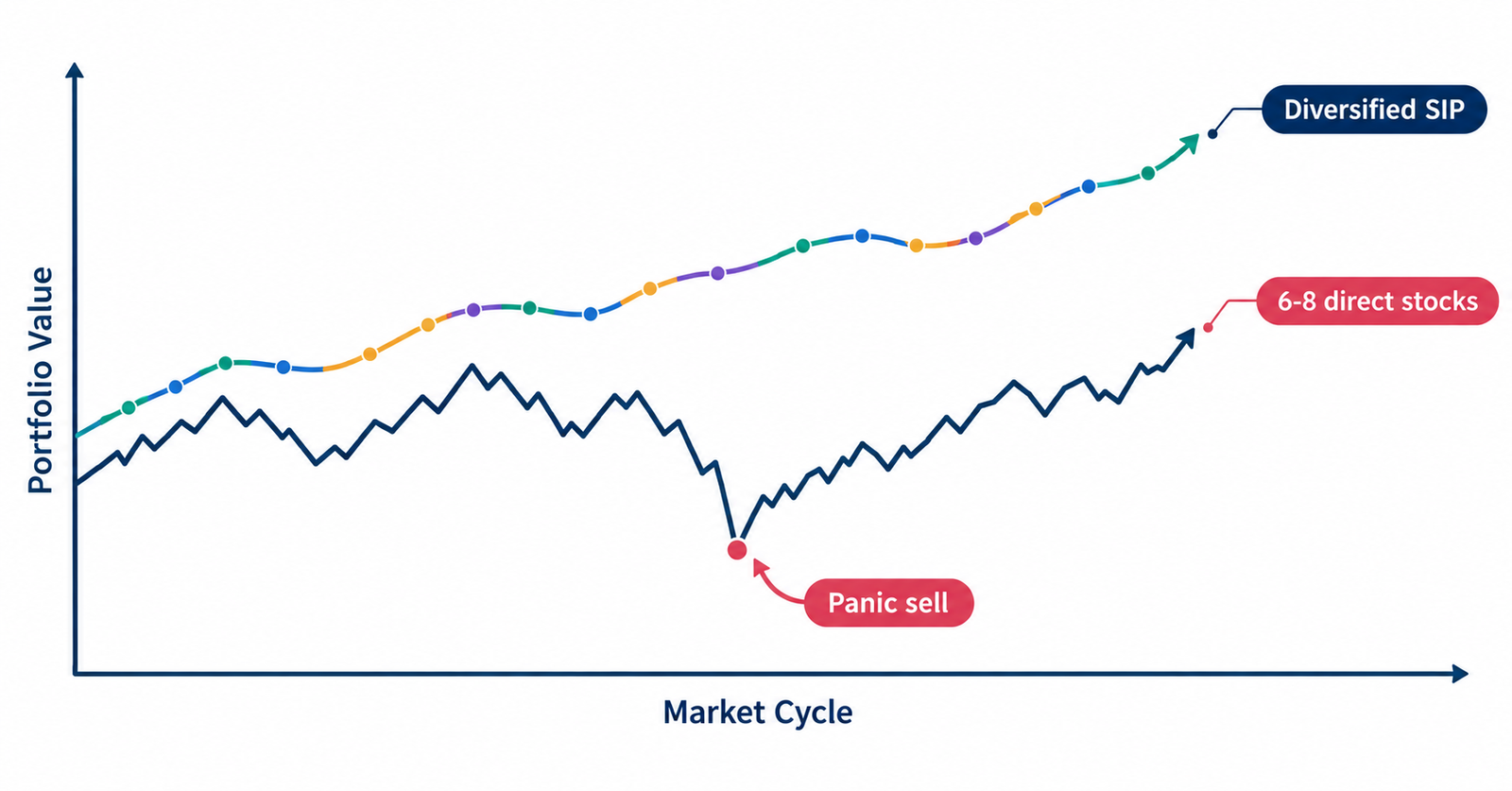
When markets fall sharply, a fund investor sees a lower number on a statement. A direct stock investor often sees red on a screen every day and a specific company they chose themselves losing value. Ego makes it personal, and personal decisions get emotional. Many people sell near the bottom and re-enter only after prices have already recovered. We have written before about how money psychology shapes these choices, and the pattern is stubbornly consistent.
Chasing tips
A stock gets recommended on social media or in a chat group after it has already gone up. By the time the tip reaches you, someone else has taken the profit. You buy at a high price on borrowed confidence, with no idea why the business is worth owning or when you would sell it.
Overtrading
Frequent buying and selling feels productive. It produces activity, and activity feels like progress. But every trade carries charges and possible tax, and most short-term moves are noise. Investors who trade less tend to earn more, which is one of the least glamorous findings in personal finance and among the most reliable.
Concentration and Diversification Risk
A typical equity mutual fund holds dozens of companies across sectors. If one of them collapses, the damage to your money is small. A retail investor with six or eight stocks has no such cushion. One accounting scandal, one regulatory action or one failed product launch can take a large bite out of the entire portfolio.
Building genuine diversification on your own is harder than it looks. Owning ten stocks that all move with the same theme, such as several banks or several IT exporters, is not diversification. It is a single bet wearing different tickers. Listing details and market data on NSE make it easy to see how concentrated an index or sector really is, and how far a handful of names can dominate.
Taxes: Where Mutual Funds and Stocks Are the Same, and Where They Differ
On equity-oriented investments, the headline rates are the same whether you hold shares directly or through an equity mutual fund. From the Union Budget of 23 July 2024, short-term capital gains on listed equity, which means gains on units or shares sold within twelve months, are taxed at 20 percent. Long-term capital gains, on holdings beyond twelve months, are taxed at 12.5 percent on gains above 1.25 lakh rupees in a financial year. Cess and surcharge may apply on top. Rules change, so confirm the current position on the income tax portal before you act.
If the rates are the same, where does the difference come from? From churn. A fund manager who buys and sells inside the scheme does not create a tax bill for you; tax arises only when you redeem your units. A direct investor who rebalances, books profits and shifts money between stocks triggers tax each time, so the more you tinker, the more you leak.
Capital gains are calculated separately from your salary income, so the choice between old and new slabs does not change how these gains are taxed. If that distinction is fuzzy, our note on the tax regime decision explains how the two computations sit side by side.
| Factor | Mutual Funds | Direct Stocks |
|---|---|---|
| Diversification | Built in across many companies | Only as wide as you build it |
| Ongoing cost | Annual expense ratio, lower in direct plans | Brokerage, statutory charges and demat fees |
| Time needed | A few hours a year for reviews | Several hours a week to do it properly |
| Skill required | Choosing suitable funds and staying invested | Reading financials, valuing businesses, timing decisions |
| Tax on selling | Only when you redeem units | Every time you sell a holding |
| Behaviour risk | Lower, but SIP stopping is common | Higher, because choices feel personal |
| Best suited to | Most investors building long-term wealth | Informed investors with time and a surplus |
When Direct Stocks Genuinely Make Sense
We are not against stock picking. It suits certain people well, and we would be misleading you if we pretended otherwise.
You Have a Real Edge
You work deep inside an industry and understand its economics better than most analysts do. That kind of knowledge, used with discipline, can be worth acting on.
You Enjoy It and Can Afford Mistakes
Your core goals are already funded, and the money you put into stocks is money you can afford to see fall. Then learning by doing is a reasonable hobby, not a threat to your future.
The Core-and-Satellite Approach
You do not have to choose one camp forever. A sensible middle path is what professionals call core and satellite. The core, usually the large majority of your equity money, sits in diversified funds, often a broad index fund or a couple of well-run flexi-cap or large-cap funds, invested through a SIP. The satellite is a small slice, commonly ten to twenty percent of your equity allocation, where you pick individual stocks.
The arrangement gives you the best of both. Your long-term goals are protected by the core, and your curiosity gets an outlet without putting the house at risk. If the satellite does brilliantly, you gain. If it does badly, it hurts but does not derail anything.
A Simple Three-Question Framework
When someone asks us whether they should be in funds or stocks, we run through three questions.
1. How many hours a week will you honestly give this?
Not the number you hope to spend, but the number you kept up over the last six months on any similar habit. If it is under two or three hours, funds are the more realistic answer.
2. How did you behave the last time markets fell hard?
Did you hold, buy more or sell? Your past behaviour predicts your future behaviour better than any risk questionnaire. If you sold in a panic, build a structure that makes selling harder.
3. What is this money for?
Money earmarked for a specific goal in the next five or six years should not sit in a concentrated stock portfolio. Long-term money, such as a retirement corpus, benefits most from steady, diversified compounding, with individual stocks as an optional extra at the edges.
Common Mistakes We See
A few errors turn up so often that they are worth listing plainly. People mistake a rising market for their own skill, and confuse a few good trades with a good process. They hold five funds that own nearly the same shares and call it diversification. They stop a SIP after a bad quarter, which is exactly when units are cheapest. They ignore that every sale has a tax consequence, and only find out at filing time. Getting the gains schedule right is part of proper return filing, and it is easier when your transactions are fewer.
Some also neglect emergency funds, insurance and debt while chasing equity returns, and that includes NRI clients managing money across two countries.
How to Start Without Overthinking It
If you are new, keep it boring. Complete your KYC, open a bank-linked account with a reputable platform and choose one or two diversified equity funds that match your goals and time horizon. Start a SIP at a level you can sustain through a bad year. Automate it so that continuing takes no effort and stopping takes a deliberate act.
Younger investors especially tend to start with enthusiasm and stall when the first correction arrives; we have looked at that pattern in our piece on Gen Z and money. Revisit the plan once a year, raise your SIP as income grows, and let time do most of the work. If, after two or three years, you still feel drawn to picking stocks, carve out a small satellite and treat it as tuition.
How Wealth & Beyond Can Help
| What You Need | How We Help | Link |
|---|---|---|
| A second opinion on your existing stocks and funds | We review overlap, concentration, costs and tax impact, and tell you plainly what to keep, trim or exit | Portfolio Review |
| Clarity on how much to invest and where | We tie your SIPs and equity allocation to real goals, such as education, a home and retirement | Financial Planning |
| Ongoing management of a growing portfolio | We build and monitor a core-and-satellite structure suited to your risk comfort | Wealth Mgmt |
| Fewer surprises on capital gains tax | We plan the timing of redemptions and sales to use exemptions and limit the tax bill | Tax Planning |
Frequently Asked Questions
Should I invest in mutual funds or direct stocks?
For most people, mutual funds are the more practical core holding because they give you diversification, professional management and a lower chance of emotional mistakes. Direct stocks can work as a smaller, optional part of the portfolio if you have the time, knowledge and spare capital.
Is direct stock investing worth it in India?
It can be, for informed investors who research carefully and hold for the long term. For many retail investors, trading costs, taxes, concentration risk and behavioural errors reduce the returns they might otherwise have earned from a diversified fund.
Why do retail investors lose money in stocks?
Common reasons include trading too often, following tips, holding a few concentrated positions, and selling in a panic during market falls. Studies by the market regulator on individual traders show that many lose money, especially in short-term and derivatives trading.
How many stocks should a beginner own?
There is no magic number, but owning too few exposes you to company-specific risk, and owning too many becomes impossible to track. Beginners are usually better off starting with diversified funds and adding a small number of well-understood stocks later, spread across different sectors.
Are mutual fund and stock returns taxed differently in India?
For equity-oriented investments, the rates are the same: short-term capital gains at 20 percent and long-term capital gains at 12.5 percent above 1.25 lakh rupees a year, as applicable from 23 July 2024. The difference is that in a fund, trades inside the scheme do not create your tax bill, while direct stock sales do.
What is the difference between SIP and direct equity investing?
A SIP is a method of investing a fixed amount regularly, usually into a mutual fund, which spreads your entry price over time. Direct equity means buying individual company shares yourself, where you choose what to buy, when to buy and when to sell.
Can I invest in both mutual funds and direct stocks?
Yes. Many investors use a core-and-satellite approach, keeping most of their equity money in diversified funds through a SIP and a small portion in individual stocks they understand well.
Do I need an advisor to invest in mutual funds?
You can invest on your own through direct plans, but an advisor helps with choosing suitable funds, setting allocations against your goals, and staying disciplined during volatile periods. What matters most is that the advice is transparent about how the advisor is paid.
Not Sure Whether Funds or Stocks Suit You?
Share your current holdings and goals with us, and we will tell you honestly what to keep, what to change and where a simple SIP could do more for you.
Book a Portfolio Conversation